Personal Injury | May 5, 2026 by JOSHUA D. ANDERSON
Right-of-Way Laws in Washington State: What Every Driver Needs to Know
Every year, thousands of Washington drivers, cyclists, and pedestrians are injured in accidents that could have been prevented if someone had simply yielded. Right-of-way violations are among the most common causes of traffic collisions in the state and one of the most misunderstood areas of traffic law.
Whether you’re navigating a busy intersection or merging onto I-5, knowing who has the right-of-way is more than a courtesy. Failing to do so can have serious consequences, including liability for an accident you caused. This guide explains Washington State’s right-of-way laws clearly, so you know exactly what the law requires of you and what it requires of the driver who hits you.
What Does “Right-of-Way” Actually Mean in Washington?
Washington’s right-of-way rules are codified, written into law, in Chapter 46.61 RCW, which governs traffic rules across the state. It is defined precisely in RCW 46.04.672:
“Vehicle or pedestrian right-of-way” means the right of one vehicle or pedestrian to proceed in a lawful manner in preference to another vehicle or pedestrian approaching under such circumstances of direction, speed, and proximity as to give rise to danger of collision unless one grants precedence to the other.
In plain terms, right-of-way becomes relevant when two parties are close enough to collide. At that point, one must yield to the other. No driver, pedestrian, or cyclist is ever automatically entitled to proceed, and Washington law makes clear that everyone on the road has a duty to exercise reasonable care, regardless of who technically has the legal right to go first.
Failing to yield is a traffic infraction that can trigger enhanced fines, particularly when a vulnerable road user such as a pedestrian, cyclist, or motorcyclist is involved, and creates a record that can be used as evidence of negligence in a personal injury case.
Washington Right-of-Way Laws by Scenario
Washington law addresses right-of-way in a wide range of situations, and the rules differ depending on the type of road, the presence of traffic control devices, and who is involved. Understanding how these rules apply in various traffic situations can help you drive more safely and protect your legal rights if you are ever involved in a collision.
Intersections With Traffic Signals
At a controlled intersection, the traffic light dictates who has the right of way. A green light means you may proceed, but you must still yield to any vehicles already lawfully in the intersection.
- When making a left turn on a green light, RCW 46.61.185 requires that you yield to any oncoming vehicles that are close enough to be a hazard, even if you have a green light.
- When a traffic light malfunctions or goes dark, RCW 46.61.183 requires every driver to treat the intersection as a four-way stop.
Four-Way Stops
Under RCW 46.61.180, the first vehicle to arrive at a four-way stop goes first. When two vehicles arrive at approximately the same time, the law establishes a tie-breaker: the driver on the left must yield to the driver on the right. Use your turn signals before proceeding so other drivers know your intentions.
Uncontrolled Intersections
An uncontrolled intersection has no stop signs, yield signs, or traffic signals, and they are more common in residential areas and at T intersections than many drivers realize. Under RCW 46.61.180, the same four-way stop tie-breaker applies: the driver to the right has the right-of-way.
Roundabouts
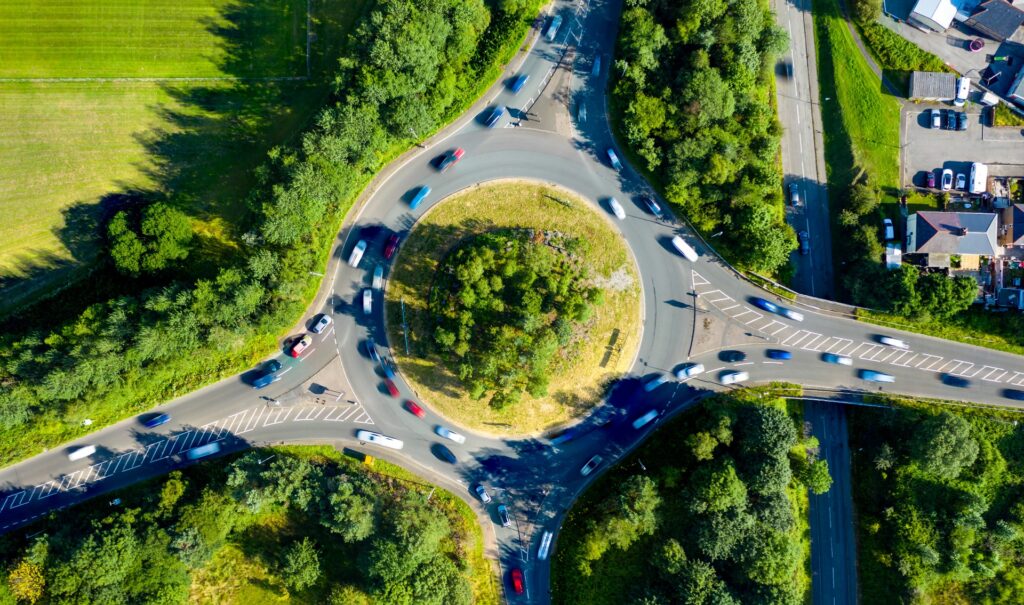
In Washington, yield signs posted at roundabout entries carry the force of law under RCW 46.61.190, which governs all stop and yield intersections. Traffic already inside a roundabout has the right of way. If you are entering, you yield and wait until there is a safe gap before pulling in.
Merging and Highway On-Ramps
RCW 46.61.205 applies the same principle to highways, private roads, and driveways: before pulling onto a public highway, you must yield to all approaching traffic. When merging onto a highway from an on-ramp, you must yield to traffic already traveling on the highway. Highway drivers are not legally required to make room for you, though many will.
Pedestrians in Crosswalks
Washington’s crosswalk law covers more than just pedestrians on foot. Under RCW 46.61.235, drivers must also yield to bicycles and personal delivery devices, the autonomous robotic devices increasingly used for sidewalk deliveries in Washington cities:
“The operator of an approaching vehicle shall stop and remain stopped to allow a pedestrian, bicycle, or personal delivery device to cross the roadway within an unmarked or marked crosswalk when the pedestrian, bicycle, or personal delivery device is upon or within one lane of the half of the roadway upon which the vehicle is traveling or onto which it is turning.”
The duty to stop applies regardless of whether it’s a marked or unmarked crosswalk, and a green light does not override it. Also, if a vehicle ahead of you has stopped for a pedestrian, you cannot pass that stopped vehicle.
When a pedestrian crosses outside of a crosswalk, RCW 46.61.240 shifts the obligation to yield onto the pedestrian. However, that does not mean a driver is free to proceed without caution. Drivers retain a general duty of care under Washington law, meaning that if you can reasonably avoid hitting someone, you are expected to do so regardless of who had the legal right of way.
School Zones and School Buses
When a school bus stops and activates its signals, you must stop before reaching the bus and wait until it moves or the signals are turned off. Under RCW 46.61.370, there are two narrow exceptions, but they apply only to drivers approaching from the opposite direction:
“(2) The driver of a vehicle upon a highway divided into separate roadways as provided in RCW 46.61.150need not stop upon meeting a school bus which is proceeding in the opposite direction and is stopped for the purpose of receiving or discharging school children.
(3) The driver of a vehicle upon a highway with three or more marked traffic lanes need not stop upon meeting a school bus which is proceeding in the opposite direction and is stopped for the purpose of receiving or discharging school children.”
If you are traveling in the same direction as the bus, you must always stop, regardless of how many lanes are on the road. The exceptions apply only to oncoming traffic on a physically divided highway or a road with three or more marked lanes total. In any other situation, you must stop.
Emergency Vehicles
When you hear or see an emergency vehicle, including ambulances, fire trucks, and police cars, approaching with flashing lights and sirens, pull to the right, clear any intersection, stop, and stay stopped until the emergency vehicle passes. That is the core of RCW 46.61.210.
Washington’s Move Over law under RCW 46.61.212 extends the legal duty to yield to stationary emergency and work zone vehicles as well. On multi-lane highways, drivers must change lanes away from the stopped vehicle when it is safe to do so. On roads with fewer lanes, they must slow down and proceed with caution. Failure to comply is a statutory violation that carries doubled fines, and recklessly endangering emergency or work zone workers is a gross misdemeanor.
Fines in these zones are doubled, and recklessly endangering emergency or work zone workers is a gross misdemeanor.
Transit Vehicles
When a public transit bus has stopped to pick up or drop off passengers and signals to re-enter traffic, drivers must yield. RCW 46.61.220 places that obligation on drivers to allow enough space for the bus to merge safely back into traffic.
Bicyclists and Motorcyclists
Cyclists and motorcyclists on public roads have the same legal rights as drivers and are subject to the same right-of-way rules. You must yield to bicycles in bike lanes and on shared roadways the same way you would yield to any other vehicle. RCW 46.61.755 specifically prohibits motor vehicles from impeding or obstructing a lawfully operating bicycle. Failing to yield to a cyclist or motorcyclist carries the same legal exposure as failing to yield to a car.
Notably, both cyclists and motorcyclists qualify as vulnerable users of a public way under Washington law, meaning that when a driver fails to yield to them, enhanced fines apply on top of the standard infraction penalty.
Emerging From an Alley, Driveway, or Building
RCW 46.61.365 governs drivers within a business or residence district who are exiting an alley, driveway, or building. The statute requires you to stop before crossing the sidewalk or, where no sidewalk exists, the sidewalk area extending across the alleyway or driveway. You must then yield to any pedestrians in that area before proceeding, and yield to all vehicles on the roadway before entering traffic. Fault in these accidents almost always falls on the driver who failed to yield, making this one of the more straightforward liability scenarios in Washington personal injury cases.
Starting From a Parked Position
Before pulling away from a curb, signal your intention and wait for a safe gap in traffic. RCW 46.61.300 requires you to yield to all approaching traffic before entering the lane. Skipping this step is a common cause of sideswipe collisions on busy city streets.
How Is Right-of-Way Fault Assigned in a Washington Personal Injury Case
When a right-of-way violation causes an accident, it plays a central role in determining legal responsibility. In Washington personal injury law, negligence is the foundation of most car accident claims, and a documented right-of-way violation is powerful evidence of negligence.
Washington’s Comparative Fault Rule
Washington is a pure comparative fault state under RCW 4.22.005, which means that even if you share some responsibility for an accident, you retain the legal right to recover damages. Your compensation is reduced in proportion to your share of fault but is not eliminated.
For example, if you are found 20% at fault and your total damages are $100,000, you would recover $80,000.
This is a critical protection that ensures injured people are not shut out of compensation simply because another driver claims partial fault against them.
What If the Other Driver Claims You Failed to Yield?
In right-of-way disputes, it is common for both drivers to blame each other, which is exactly why evidence gathered at the scene is so important.
Under RCW 4.22.070, when more than one party shares responsibility for a crash, a jury or judge assigns each party a percentage of the total fault based on their conduct and how much it contributed to the accident. That includes the drivers involved and any other person or entity whose actions played a role. Compensation is then reduced by the percentage of fault.
An experienced personal injury attorney can investigate the collision, work with accident reconstruction professionals, and make sure the other driver’s statutory violations are clearly documented so that fault is divided as accurately as possible.
What To Do After an Accident Caused by a Right-of-Way Violation
The steps you take immediately after a collision can have a direct impact on your ability to recover fair compensation.
- Call 911. A police report creates an official record of the accident, including the officer’s observations about who may have failed to yield. This document is often the cornerstone of a personal injury claim.
- Document the scene. Take photographs of vehicle positions, damage, skid marks, road conditions, and any visible injuries. If there is a traffic light nearby, note whether it was functioning and document the intersection layout.
- Gather witness information. Bystanders and other drivers who saw the accident can provide independent accounts of who had the right-of-way. Get names and phone numbers before people leave the scene.
- Seek medical attention immediately. Some injuries, including concussions and soft tissue damage, do not show symptoms right away. A medical record created close in time to the accident links your injuries to the collision and protects your claim. More importantly, being examined by a doctor should be considered to rule out serious injuries and concerns.
- Avoid discussing fault at the scene. Do not apologize or speculate about what happened. Exchange insurance and contact information, and let the investigation do its work.
- Contact a personal injury attorney before speaking with the insurance company. Insurance adjusters may reach out quickly after an accident to settle your claim as cheaply as possible, often before you know the full extent of your injuries.
How Anderson Law | Injury Attorneys Can Help
Right-of-way accident cases can become complicated quickly, especially when fault is disputed, multiple parties are involved, or serious injuries require significant compensation. Anderson Law Injury Attorneys has deep experience handling Washington car accident cases, including those involving failure to yield, pedestrian accidents, and intersection collisions.
Our experienced team investigates the full circumstances of every accident we handle, gathering police reports, requesting traffic and surveillance footage, working with accident reconstruction professionals when necessary, and building a thorough case documenting exactly how the other driver’s right-of-way violation caused your injuries. We understand how Washington’s comparative fault rules work and how to counter attempts to shift blame onto our clients.
If you or a loved one has been injured in an accident caused by a right-of-way violation, you deserve to know your options. Contact Anderson Law today for a free consultation. There is no fee unless we win your case.
The information contained on this website is intended for informational purposes only, and is not legal advice. Nothing in this website establishes an attorney-client relationship between us. Different facts can dramatically affect a legal opinion. You should consult an attorney for legal advice that pertains to your personal situation.

Joshua D. Anderson
Attorney Joshua D. Anderson grew up in Enumclaw, Washington with a close-knit family who instilled in him the values of faith, family, and hard work. Since a young age, Josh knew he wanted to be an attorney so he could advocate for others and always knew his focus would be personal injury. He completed his undergraduate degree at the University of San Diego and graduated Cum Laude from Seattle University School of Law. While pursuing his degree, Josh served as an extern for the Seattle City Attorney’s Office.