Personal Injury | August 21, 2026 by JOSHUA D. ANDERSON
A Guide to Washington’s Driving Offense Classifications
If you’ve been in a car accident or received a ticket, the driver’s conduct probably falls somewhere on a spectrum you may not have thought much about before now. Washington law treats a momentary lapse in attention very differently than a deliberate disregard for other people’s safety, and the difference isn’t just semantic. It determines whether an offense is a $250 ticket or a felony, and it shapes what evidence is available if you go on to pursue a personal injury claim.
This article walks through that full spectrum, from Washington’s least serious traffic infractions to its most serious felony driving offenses, so you can see where a specific charge, or a specific driver’s conduct, actually lands.
Careless Driving vs Reckless Driving Under Washington Law
Washington doesn’t have a charge called “careless driving.” Some states, like Florida and Oregon, do. What most people mean when they say “careless driving” is covered here under negligent driving, and Washington treats that as a meaningfully different offense from reckless driving. The two are easy to use interchangeably in everyday conversation, but they sit at different points on Washington’s classification system, with different standards of proof and very different consequences, covered in the next section.
Understanding Washington’s Offense Classifications
Before comparing negligent driving and reckless driving directly, it helps to understand the three tiers Washington uses to classify driving offenses generally.
- Traffic infraction. A civil matter resolved with a fine. It does not create a criminal record and does not carry jail time.
- Misdemeanor and gross misdemeanor. Criminal offenses. A misdemeanor is punishable by up to 90 days in jail. A gross misdemeanor is punishable by up to 364 days in jail. Both result in a criminal record.
- Felony. The most serious classification, punishable by time in a state correctional facility rather than county jail. Felonies are further divided into Class A, B, and C, with Class A carrying the longest potential sentences.
Where a driving offense falls in this system affects far more than the criminal penalty. It shapes what evidence is available if you pursue a personal injury claim, discussed further below.
Driving Offenses in Washington Ranked by Severity
The offenses below run from least to most serious. Several sit close together in everyday language, but they rest on different legal standards, and the classification attached to each one determines the stakes for the driver involved.
| Offense | RCW | Qualification | Classification | Potential Penalty |
| Negligent Driving, Second Degree | RCW 46.61.525 | Operating a vehicle in a manner that is negligent and endangers or is likely to endanger a person or property, with no signs of impairment | Traffic infraction | $250 fine |
| Distracted Driving | RCW 46.61.672 / RCW 46.61.673 | Using a personal electronic device while driving, or engaging in other distracting behavior such as eating or grooming in combination with another violation | Traffic infraction | $136 first offense, $234 for a repeat offense within five years, an additional $99 for a dangerously distracted citation |
| Negligent Driving, First Degree | RCW 46.61.5249 | The same negligent conduct as second degree, plus exhibiting signs of alcohol or drug impairment | Misdemeanor | Up to 90 days in jail, up to $1,000 fine |
| Reckless Driving | RCW 46.61.500 | Driving in willful or wanton disregard for the safety of persons or property | Gross misdemeanor | Up to 364 days in jail, up to $5,000 fine, minimum 30-day license suspension |
| DUI | RCW 46.61.502 | Operating a vehicle with a BAC of 0.08 or higher, or while under the influence of alcohol or drugs | Gross misdemeanor, elevated to a felony with qualifying prior offenses | Up to 364 days in jail, up to $5,000 fine, license suspension, ignition interlock requirement |
| Vehicular Assault | RCW 46.61.522 | Driving under the influence, in a reckless manner, or with disregard for the safety of others, causing substantial bodily harm | Class B felony | State prison sentencing range, mandatory license revocation |
| Vehicular Homicide | RCW 46.61.520 | The same conduct standards as vehicular assault, resulting in death within three years of the injury | Class A felony | State prison sentencing range, mandatory license revocation |
Infraction-Level Driving Offenses
At the infraction level, two offenses cover the everyday failures that create risk without any element of intent or impairment.
- Negligent driving, second degree, is the closest legal equivalent to what most people mean by “careless driving.” It applies when a driver fails to exercise ordinary care in a way that endangers or is likely to endanger a person or property. There is no intent requirement and no sign of impairment involved. Common examples include following too closely, misjudging a turn, failing to yield the right of way, or failing to check a blind spot before merging. Because it is classified as a traffic infraction, it is resolved as a civil matter with a fine and does not produce a criminal record.
- Distracted driving is a specific, commonly cited example of careless conduct rather than a separate legal category from negligence. Washington addresses it directly under RCW 46.61.672, which prohibits using a handheld personal electronic device while driving, and RCW 46.61.673, which covers other distracting behavior like eating or grooming. The electronics statute is a primary offense, meaning an officer can stop a driver for it alone. The broader distraction statute is secondary, meaning it applies only alongside another citation.
Misdemeanor-Level Driving Offenses
Once impairment or intent enters the picture, the offense moves from a civil infraction into criminal territory.
- Negligent driving, first degree involves the same underlying conduct as second degree negligent driving, with one addition: the driver exhibits signs of having consumed alcohol, marijuana, or another drug. That addition moves the offense from a civil infraction to a criminal misdemeanor, carrying up to 90 days in jail and a $1,000 fine, even without a formal DUI-level breath or blood test.
- Reckless driving requires more than a failure to exercise care. Under RCW 46.61.500, the driver must have operated the vehicle in willful or wanton disregard for the safety of persons or property, meaning conscious disregard for a known risk rather than a mistake or momentary lapse. This is the core distinction between negligent and reckless driving. Negligence is about a failure of care. Recklessness is about a state of mind. Reckless driving is a gross misdemeanor, carrying up to 364 days in jail, a $5,000 fine, and a mandatory 30-day license suspension.
- DUI sits in the same misdemeanor-level classification as reckless driving in its baseline form, but it is defined by intoxication rather than by a standard of care. A driver can be charged under RCW 46.61.502 either for having a blood alcohol concentration of 0.08 or higher, or for being under the influence of alcohol or drugs regardless of a specific number. A first or second DUI is a gross misdemeanor. Washington elevates DUI to a felony once a driver has three or more qualifying prior offenses within 15 years, or has a prior alcohol- or drug-related vehicular assault or vehicular homicide conviction, under RCW 46.61.5055.
Felony-Level Driving Offenses
When any of the conduct above results in serious injury or death, the offense moves into felony territory.
- Vehicular assault applies when a driver operating under the influence, driving recklessly, or driving with disregard for the safety of others causes substantial bodily harm to another person. Under RCW 46.61.522, it is a Class B felony, carrying a state prison sentencing range rather than a jail term, along with mandatory license revocation.
- Vehicular homicide applies the same three conduct standards, impairment, recklessness, or disregard for safety, to cases where the injury results in death within three years. Under RCW 46.61.520, it is a Class A felony, the most serious classification available under this set of statutes.
Where a DUI overlaps with either of these outcomes, the case is typically charged as vehicular assault or vehicular homicide rather than as felony DUI, since the injury or death elevates the conduct into its own felony category.
How These Classifications Affect a Personal Injury Claim
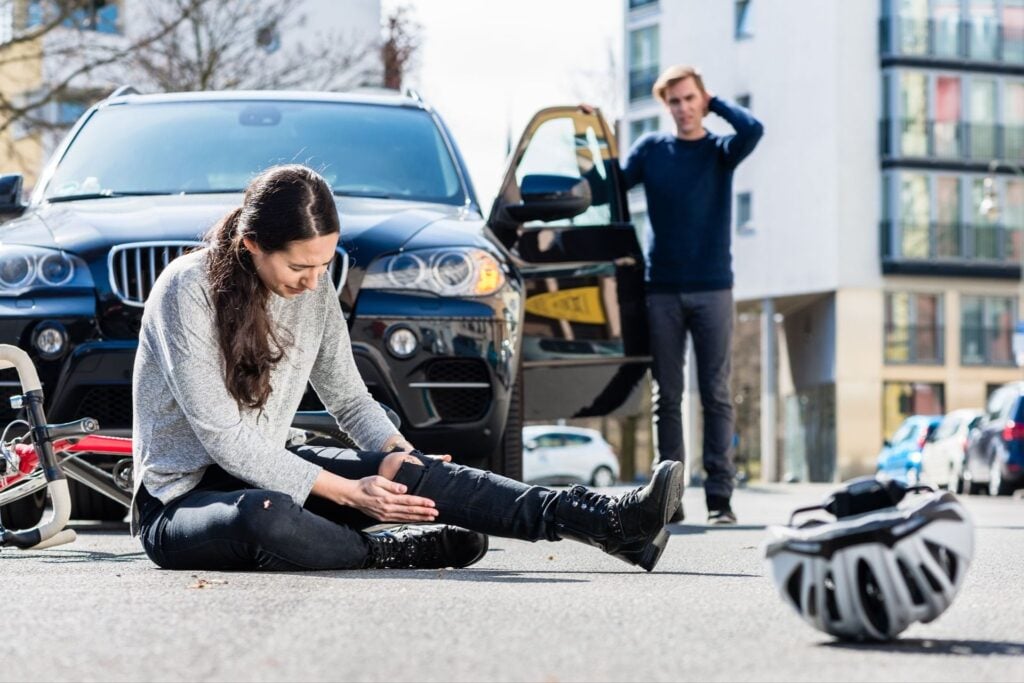
The classification of a driving offense matters for the criminal case, but it does not by itself decide a personal injury claim. Washington operates under comparative fault, RCW 4.22.005, which means a jury or insurer weighs the percentage of fault each party holds in the specific incident, as in cases involving a rear-end collision. A reckless driving conviction, or even a felony vehicular assault charge, can serve as strong evidence of fault, but civil liability is still established separately, through the ordinary elements of a negligence claim rather than through the criminal outcome alone.
It’s also worth noting plainly that Washington does not allow punitive damages in personal injury cases, regardless of how serious the underlying conduct was. Compensation in a civil claim is tied to the harm the injury victim actually experienced, not to punishing the at-fault driver.
Talk to a Washington Personal Injury Attorney
Washington’s driving offenses span a wide range, from a $250 infraction for a momentary lapse in attention to a Class A felony when a driver’s conduct proves fatal. “Careless” and “reckless” aren’t interchangeable, and neither one automatically decides who’s at fault in a civil claim. What matters most after an injury is understanding where the other driver’s conduct actually falls, and what that means for the case you’re building.
Contact Anderson Law | Injury Attorneys for a free case evaluation if you were hurt by a driver anywhere on this spectrum. Our team can walk through the details with you and explain your options.
The information contained on this website is intended for informational purposes only, and is not legal advice. Nothing in this website establishes an attorney-client relationship between us. Different facts can dramatically affect a legal opinion. You should consult an attorney for legal advice that pertains to your personal situation.

Joshua D. Anderson
Attorney Joshua D. Anderson grew up in Enumclaw, Washington with a close-knit family who instilled in him the values of faith, family, and hard work. Since a young age, Josh knew he wanted to be an attorney so he could advocate for others and always knew his focus would be personal injury. He completed his undergraduate degree at the University of San Diego and graduated Cum Laude from Seattle University School of Law. While pursuing his degree, Josh served as an extern for the Seattle City Attorney’s Office.